There are many aspects of modern life that are degrading and could be fixed by pursuing an alternative method of civilization. An example of this involves the caste system which has existed in India for centuries, and grew out of the origins of Hinduism. This system divides the Hindu religion into four tiers: Brahmins, Kshatriyas, Vaishyas, and Shudras. People who are inferior but are still associated the religion of Hinduism are known as the Dalits, or untouchables. Within these castes exists numerous sub-castes that are based off of occupation. These categories have been referenced to have formed from Brahma, the Hindu God of creation. The purpose of these groups was to create a distinction between the different categories of people in India, as it is beneficial to create a regularity of society by producing a basis of order according to hierarchical power in Hinduism.
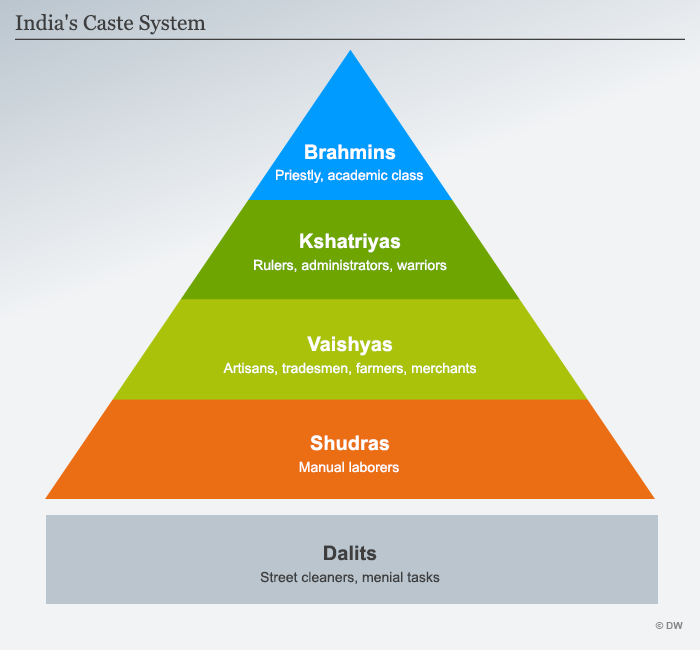
The categories created by the hierarchy can be compared to the physical qualities of Brahma, the god of creation in Hinduism. The Brahmins represent the brain of Brahma as they dominate the hierarchy as the head intellectuals and teachers of society. The Kshatriyas embody the arms and hands of the Brahma as they are the warriors and rulers. The Vaishyas represent Brahma’s thighs as they form connections with all classes of society as traders. At the bottom of the hierarchy are the Shudras who represent Brahma’s feet and perform the menial jobs of society.
The caste system has created intense divisions throughout India’s history. It has been used as a way to identify people’s worth solely based off of their social standing distinguished by their occupation. This was the initial intention of the caste system that was created centuries ago, but it is so surprising that this division still exists today among Hindus in india. Although it is tradition and has been carried in the religion since its creation, I feel like the times have evolved and the topic of division by caste should be a more flexible concept as the situations of people’s lives could be impacted by external factors that are out of a person’s control.
I have personally experienced the caste system creating a division in Indian society. My family is from South India, so my family vacations include exploring the streets and new temples in India every two years. As much as I enjoy experiencing the drastic difference in lifestyle in the villages of India, I am extremely astonished by the division of society that is created by the caste systems. People’s identification is permanently attached to a social construct that does not consider the evolution of the times. There is a significant difference in respect given to the homeless on the streets of India, and the Brahmins who hold positions of authorities in temples. I do not oppose the beliefs that Hinduism is based on, but I do not understand how a religion could not consider the epidemic of homelessness. The situation for homelessness is inevitable for millions in India, as the homelessness population in India is approximately 78.48 million.

Although the alteration of changing the construct of a strong religion such as Hinduism seems impossible, I do see an alternative to the way people can be evaluated as people. I think that judging people’s piety and actions towards bettering themselves in the religion can be more effective than evaluating them based off of social class. While this is a broad generalization, I do feel that the homeless population in India turns toward religion in order to ease their apprehensions about their current state in life. Thus, I feel as if the Shudras and Dalits can be equally valued as individuals in the Hindu religion. Although the different castes may occupy different occupations, their commitment to the religion should value their worth over the social construct created by the caste system.
Bibliography
- “What Is India’s Caste System?” BBC News, BBC, 20 July 2017
- “Religion: Hinduism.” BBC, BBC
 Uncovering Culture